


Sadasivan Shankar
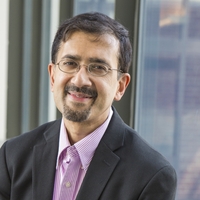
Biography
Sadasivan (Sadas) Shankar is currently the first Margaret and Will Hearst Visiting Lecturer in Computational Science and Engineering at Harvard School of Engineering and Applied Sciences, where he is involved in teaching and research in the areas of large-scale computational methods, chemistry, materials, and in translational ideas. In fall 2013, as the first Distinguished Scientist in Residence at the Institute of Applied Computational Sciences in Harvard, he co-instructed a graduate-level class on Computational Materials Design, which covered fundamental atomic and quantum techniques and practical applications for new materials by design.
Dr. Shankar earned his Ph.D. in Chemical Engineering and Materials Science from University of Minnesota, Minneapolis. Sadasivan has initiated and led multiple efforts in the electronics industry, most recently the Materials Design Program in Intel. He is a co-inventor in over 20 patent filings covering areas in new chemical reactor designs, semiconductor processes, bulk and nano materials, device structures, and algorithms. He is also a co-author in publications and presentations in the areas of chemical synthesis, plasma chemistry and processing, Monte Carlo and molecular dynamics methods, non- equilibrium electronic, ionic, and atomic transport, chemical reactive systems, and methods for experimental characterization and high throughout calculations for material interfaces.
Dr. Shankar has been also involved in several collaborative national and international efforts with Semiconductor Research Corporation, Sematech, National Institute of Standards and Technology, Department of Energy, and President’s Materials Genome Initiative.
Dr. Shankar earned his Ph.D. in Chemical Engineering and Materials Science from University of Minnesota, Minneapolis. Sadasivan has initiated and led multiple efforts in the electronics industry, most recently the Materials Design Program in Intel. He is a co-inventor in over 20 patent filings covering areas in new chemical reactor designs, semiconductor processes, bulk and nano materials, device structures, and algorithms. He is also a co-author in publications and presentations in the areas of chemical synthesis, plasma chemistry and processing, Monte Carlo and molecular dynamics methods, non- equilibrium electronic, ionic, and atomic transport, chemical reactive systems, and methods for experimental characterization and high throughout calculations for material interfaces.
Dr. Shankar has been also involved in several collaborative national and international efforts with Semiconductor Research Corporation, Sematech, National Institute of Standards and Technology, Department of Energy, and President’s Materials Genome Initiative.
Presentations
Invited Talk


Applications
Architectures
Introductory
